
Traditional finance has arrived
On 27 March, ICE completed its US$2bn investment in Polymarket, deploying a final US$600mn cash tranche to fulfil a commitment first made in Oct 2025. The strategic objective is data, not equity returns: ICE intends to distribute Polymarket's real-time event probabilities to institutional clients globally as a new intelligence layer alongside futures curves and sell-side surveys.
Kalshi's valuation tells the same story from a different angle. Its March 2026 funding round valued the platform at US$22bn — double its December figure — after monthly trading volume reached US$10.4bn and annualized revenue hit an estimated US$1.5bn. In a recent interview, its founders laid out an ambitious roadmap: evolving beyond yes/no binaries into futures, options, swaps on macro, AI compute, weather - aiming to become the world's largest derivatives exchange.
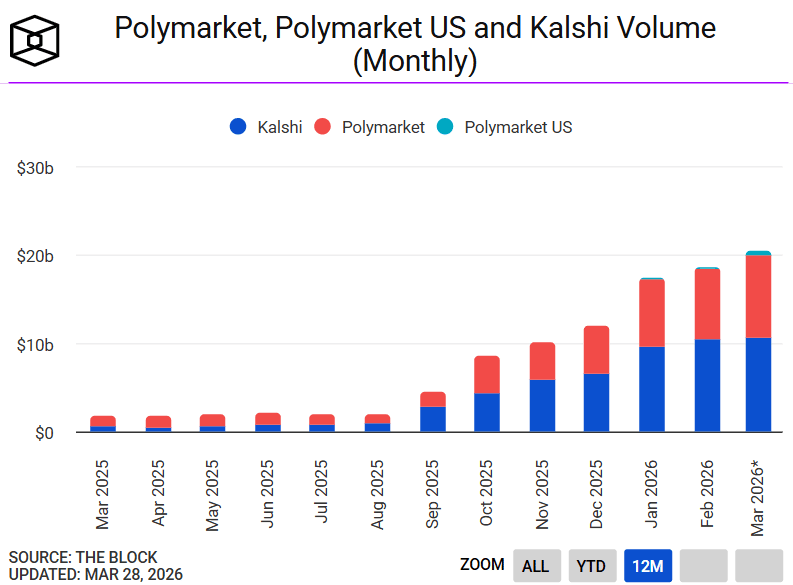
Source: The Block
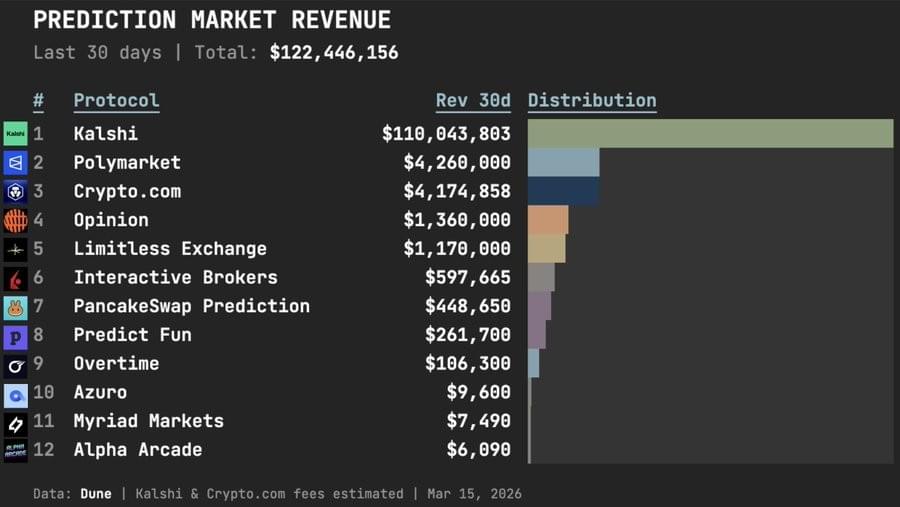
Source: Dune Analytics, @PredictParity *Kalshi charges ~1% on notional volume, Polymarket ~0.05%
The product frontier is widening - fast
The most significant market structure development is Kalshi's approval for margin trading. On 24 March, Kalshi's affiliate Kinetic Markets LLC was registered as a futures commission merchant (FCM) by the National Futures Association, a prerequisite to offer non-fully-collateralized positions, and a first for any dedicated prediction market exchange. Until now, all participants posted 100% of contract value as collateral, a constraint that made large-scale deployment by hedge funds and prop desks impractical. CFTC rulebook approval is still required before launch, but the institutional rails are being built in parallel: clearing via Fidelity Information Services, data distribution through Tradeweb, and a new research partnership with ARK Invest, all announced in the same week.
On the sports side, MLB named Polymarket its Official Prediction Market Exchange (reported 3-year, US$300mn deal), granting exclusive access to MLB IP and official Sportradar data. The partnership matters strategically: sports currently accounts for ~40% of Polymarket's volume versus over 70% at Kalshi, leaving meaningful room to grow. Official data and branding access accelerates that.
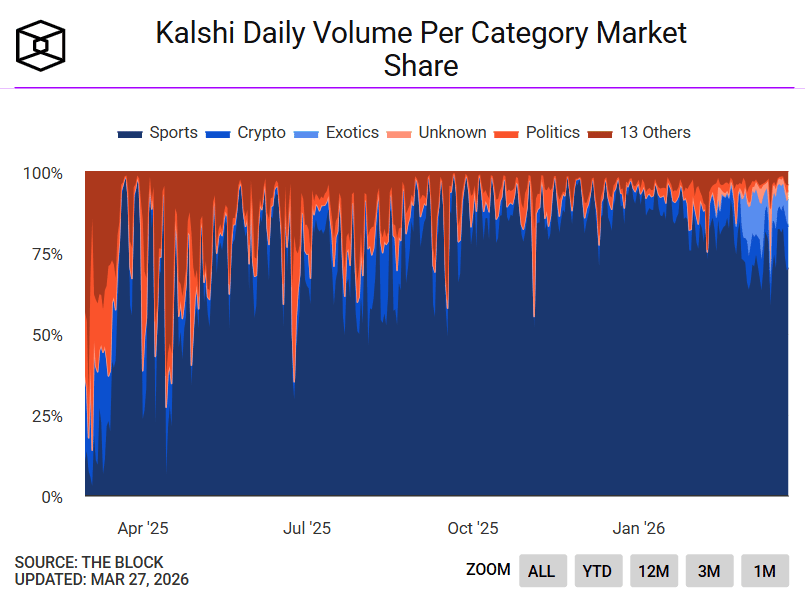
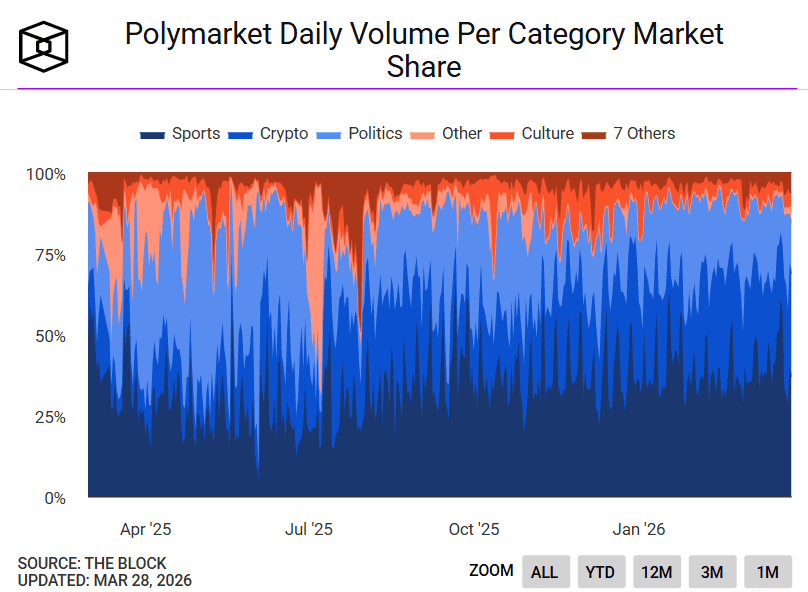
Source: The Block
Scrutiny is the price of scale
The industry's rapid growth has drawn an equally rapid legislative response. The PREDICT Act, introduced on 25 March on a bipartisan basis, would ban the President, Vice President, members of Congress, senior political appointees, and their immediate families from trading on any contract tied to elections, legislation, or government actions, with penalties of a 10% transaction fine and full profit forfeiture. It is one of at least seven prediction market bills introduced in 2026.
The legislative surge was catalysed by a pattern of suspiciously timed trades: a new Polymarket account wagered US$30,000 on Nicolás Maduro's removal hours before a US operation captured him, earning US$400,000; analytics firm Bubblemaps separately flagged accounts earning nearly US$1mn on Iran strike contracts with success rates above 90%; Israeli authorities have since indicted two individuals - including a military reservist - for allegedly trading on classified information during the Iran war. While no direct link to US officials has been established, the cumulative pattern has made political inaction untenable.
Platforms are responding with tighter controls. On 23 March, Polymarket published a cross-platform integrity framework banning trading on stolen confidential information, illegal tips, and outcome-influencing positions; its U.S. venue uses layered surveillance and NFA-linked enforcement. Kalshi has restricted participation by politicians, athletes, and referees in relevant markets.
The key unresolved issue is jurisdictional mismatch: Polymarket’s enhanced controls and the MLB partnership apply to its U.S.-regulated exchange (~US$700mn notional), while most activity remains on its international DeFi platform (~US$19bn monthly) under a lighter rulebook. How regulators and partners address this gap will shape the next phase of industry adoption.