
What is a prediction market?
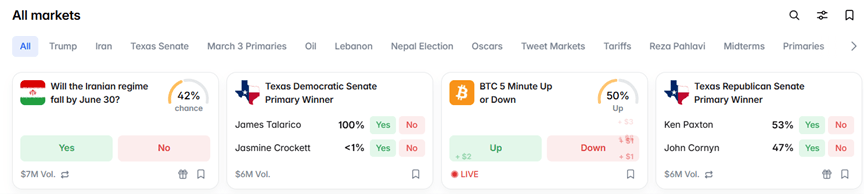
A prediction market is a marketplace where people trade contracts whose payoff depends on whether a specific event happens, such as “Fed cuts rates by 50 bps in June” or “Candidate X wins the election.”
Source: Polymarket
These contracts are usually binary options that pay a fixed amount(for example, 1 dollar) if the event occurs and 0 if it does not, so a price of 0.65 can be read as a 65% implied probability under standard assumptions. Because traders put real money behind their views, the market price aggregates dispersed information into a real‑time forecast of how likely the outcome is.
For investors, that means prediction markets function both as an information signal (forward‑looking probabilities) and as a new venue for expressing macro, geopolitical, and thematic views with clearly defined payouts.
Major platforms and market growth
The commercial landscape now spans regulated U.S. venues, crypto‑native platforms, and specialist political exchanges. Key platforms include:
- Kalshi – a CFTC‑designated contract market that lists event contracts on U.S. politics, macro data releases, and policy decisions, and operates as a fully regulated derivatives exchange and distribute via partners such as Robinhood. Its annualized trading volume has jumped from around US$300mn to over US$50bn in a year, with 5mn of active monthly users and a US$11bn valuation.
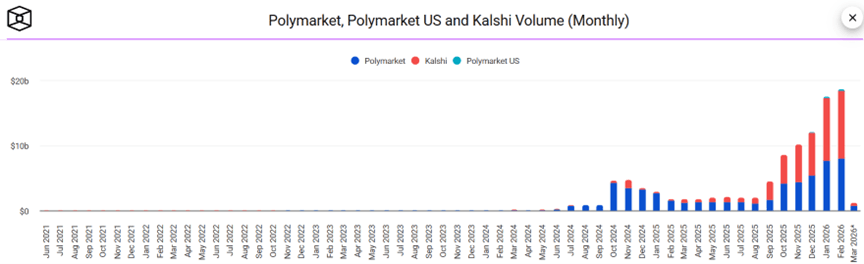
- Polymarket – An on-chain global prediction market offering contracts on politics, economics, culture, and sports, with real‑time, low-friction trading for crypto users. Monthly trading volume reached US$7.9bn in Feb 2026, more than 5 times higher than a year earlier, with over 3mn monthly active users and a US$11.6bn valuation, backed by ICE.
Trading activity in prediction markets has grown rapidly since the 2024 US Presidential Election, with total monthly betting volume surpassing US$20bn by Feb 2026.
Source: The Block
What was once a niche is now viewed as a potential “trillion‑dollarindustry” by the end of the decade, contingent on regulatory normalization and broader institutional adoption. Growth has been driven by platforms like Kalshi, Polymarket, as well as by the expansion of prediction contracts into sports, entertainment, weather, and crypto‑asset outcomes, which broaden the user base beyond purely political or macro traders.
Why prediction markets are special?
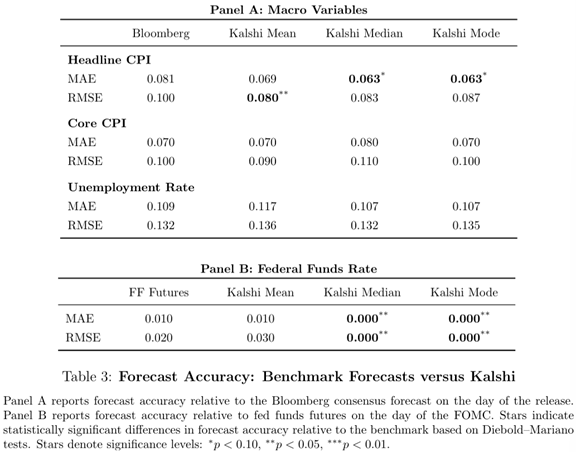
A recent Federal Reserve paper highlights Kalshi’s macro markets as acredible new source of economic expectations. The study found that Kalshi‑implied distributions react quickly to new information, and forecast as well as - sometimes even better than - established benchmarks like the Survey of Market Expectations and the Bloomberg consensus. For investors, this positions prediction markets as a complementary information set alongside futures curves, options‑implied distributions, and sell‑side surveys.
Source: Federal Reserve
Key features include:
1) Richer distribution, faster updates
Instead of a single forecast (“CPI will be 3.1%”) , prediction markets provide a full probability distributions that evolve continuously—especially around major data releases or Fed meetings. For investors, the distribution’s shape—its tails, skew, and level of uncertainty—often matters more than the consensus number itself, since it influencesrisk appetite, hedging needs and position sizing.
2) Improved policy-rate signaling
Kalshi’s forecast for each FOMC meeting hasmatched the realized policy rate since 2022—beating both surveys and fed funds futures. That makes these markets a potentially valuable input into rate‑sensitive strategies, curve trades, and cross‑asset positioning around central‑bank decisions.
3) Broader participation and sentiment
Retail and institutional traders participate side by side, providing a fresh view of how sentiment builds outside conventional analyst, options, or futures markets. For discretionary investors and risk managers, this can offer a real‑time read on crowd expectations for discrete events that are otherwise hard to observe.
Information moves faster than news
Prediction markets do more than forecast outcomes; they also reveal how information spreads - sometimes before traditional media or even listed markets can react.
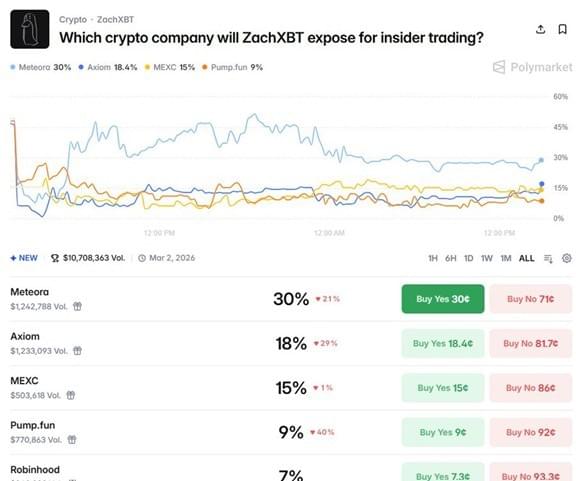
- Fraud and governance: When on-chain investigator @ZachXBT teased an insider-trading exposé, trading volume on related Polymarket contracts surged beyond US$10mn within 48 hours, amid speculation that individuals connected to the company had taken large positions ahead of the disclosure. Such episodes illustrate both the strength and risk of prediction markets: they can surface hidden information early, yet they can also amplify rumor‑driven speculation.
Source: Polymarket
- Geopolitical shocks: During the 28 Feb US-Israel strike on Iran, users continued to trade contracts linked to the event while traditional financial markets were closed, offering an additional venue to express or hedge risk around the episode. At the same time, analytics provider @bubblemaps flagged six suspected insiders who allegedly earned about US$1.2mn betting ahead of the strike, raising familiar concerns around insider trading in decentralized markets.
Why it matters for investors
Even with unsolved questions around insider activity and marketintegrity, prediction markets are increasingly relevant as tools for information, risk management, and return generation.
Key use cases include:
- Scenario analysis
Portfolios can be stress‑tested against real‑time event probabilities rather than backward‑looking narratives. For example, investors can translate market‑implied probabilities of rate cuts, election outcomes, or regulatory actions directly into portfolio scenarios. - Geopolitical and event-risk gauges
For discrete events—elections, referenda, policy decisions, conflict escalations—prediction markets often adjust more rapidly than proxies like the VIX, oil options, or CDS spreads. This can support tactical positioning or hedging around binary or lumpy outcomes that are not easily captured by standard factor models. - Tail‑risk hedging and targeted exposure
Event contracts allow investors to isolate specific macro, policy, or thematic risks (for example, energy supply disruptions, defense spending shocks, or climate‑linked events) with clearly defined payoff profiles. That makes them a potential complement to options, structured products, and OTC hedges, especially when those markets are illiquid or expensive.
From an allocation standpoint, prediction‑linked exposures could be viewed as a satellite sleeve within alternatives, macro trading, or overlay strategies, depending on mandate and risk constraints.
Adoption, participants, and institutionalization
It is not surprising that major quantitative trading firms such as DRW, Jump Trading, and Susquehanna are building dedicated prediction‑market trading desks. Their involvement signals that market‑making, statistical arbitrage, and cross‑market relative‑value strategies are emerging around these contracts, improving liquidity and price efficiency.
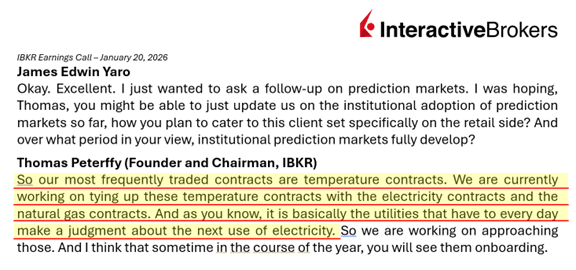
On Interactive Brokers' latest earnings call, management highlighted that weather and temperature contracts are now among the most traded products on its platform, with utility companies increasingly exploring them to hedge electricity and natural gas exposure.
In parallel, established derivatives exchanges such as CME have launched event contracts, while Cboe Global Markets and Nasdaq have filed to list “all‑or‑nothing” options subject to regulatory approval.
On the asset‑management side, Bitwise has filed with the SEC for prediction‑market‑backed ETFs, a step that could bring these markets from the fringes of Web3 into the core toolkit of traditional wealth and asset‑management channels. As regulation, infrastructure, and usage continue to mature, it becomes easier to imagine prediction‑market data sitting alongside futures curves and survey‑based forecasts on standard terminals, with event contracts or related products accessible through conventional brokers or ETF‑like wrappers.
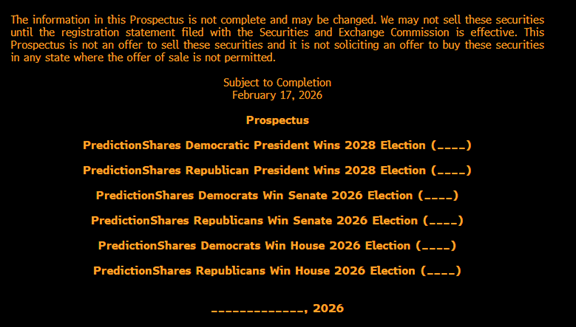
Source: Bitwise Filing
For investors, understanding how prediction markets function—and how to interpret their signals—looks increasingly likely to become part of the standard toolkit for macro, multi‑asset, and risk‑aware portfolios rather than a curiosity reserved for speculators.